How to Make Your Website Visible in Google AI Mode and AI Overviews in 2026
Search is changing from a list of links into a more conversational discovery experience. People increasingly ask detailed questions and receive summarized responses through Google features such as AI Overviews and AI Mode.
This raises an important business question: will AI-powered search identify your website as a useful supporting source, or will your content remain invisible?
The practical answer is encouraging. Google says the same foundational SEO practices continue to matter because its generative AI features are rooted in core Search ranking and quality systems. There is no secret AI-ranking formula. A crawlable website, useful content, visible expertise and a strong page experience remain the foundation.
1. What Has Changed in Google Search?
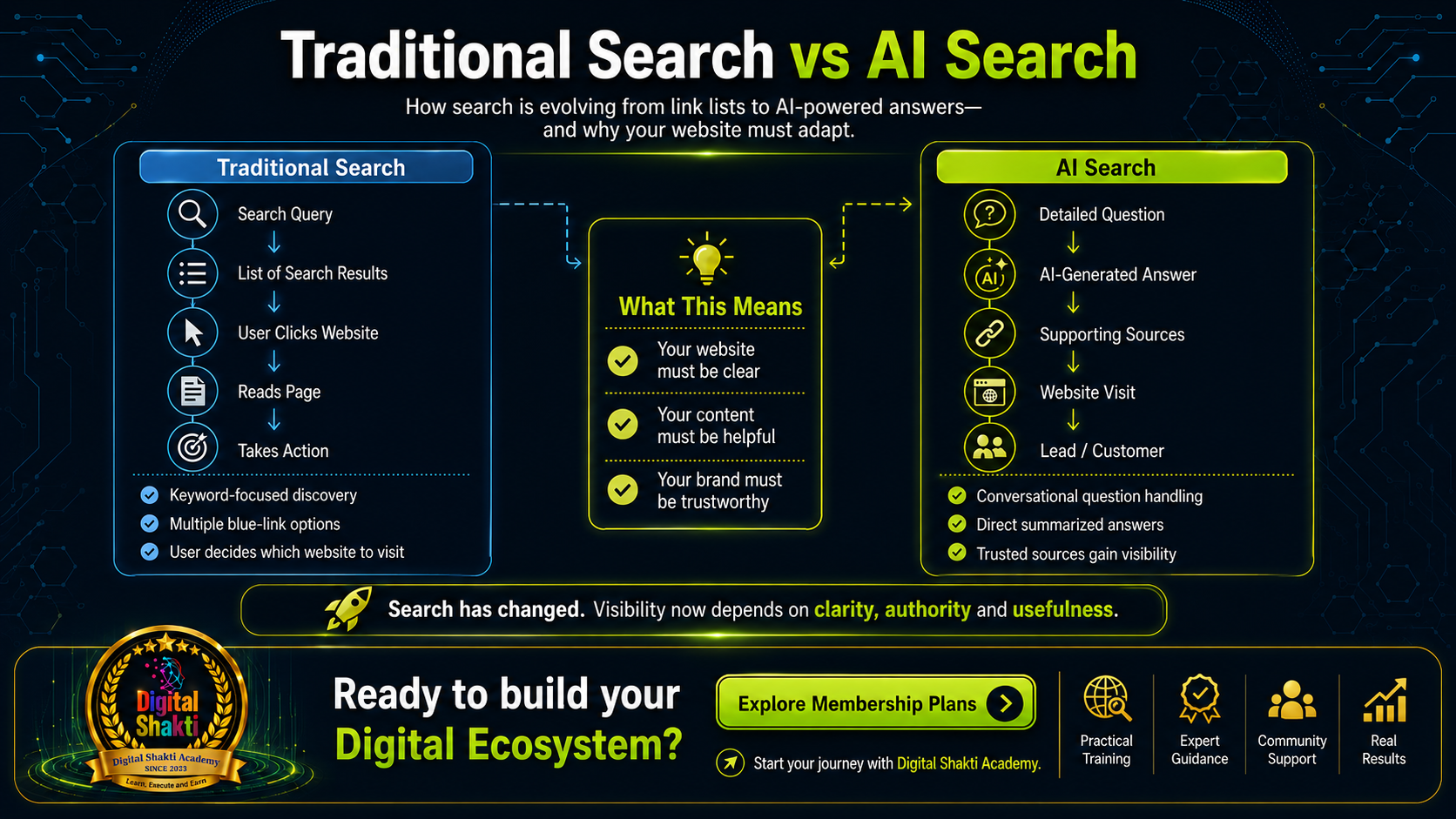
Traditional search often followed a simple path: a user entered a query, reviewed a list of results and clicked a website. AI-powered search may answer a detailed question first, then show supporting sources and links for deeper exploration.
For businesses, this means visibility is no longer only about winning a blue-link position. Your pages may also be considered as supporting sources within AI-generated experiences. To be eligible, a page must be indexed and eligible to appear in Google Search with a snippet; Google states that there are no additional technical requirements specific to AI Overviews or AI Mode. Eligibility never guarantees selection.
Your website should make the following facts easy to understand:
- Who you are, what you offer and which audience you serve.
- What specific question or customer problem each page answers.
- What original experience or expertise supports the information.
- Why the visitor should trust the business and the author.
- What the visitor should do after reading the page.
2. Is Traditional SEO Still Relevant?
Yes. Google’s official 2026 guide states that SEO remains relevant because AI Overviews and AI Mode use core Search ranking and quality systems, including retrieval from the Search index. Terms such as AEO and GEO may describe an industry focus, but from Google’s perspective, optimization for generative AI Search is still SEO.
Continue to strengthen:
- Keyword and audience research based on genuine customer questions.
- Technical SEO, crawling, indexing, canonicalization and internal linking.
- Helpful, expert-led and people-first content.
- Mobile usability, speed and a clean page experience.
- Relevant structured data that matches visible content.
- Search Console monitoring and lead-conversion measurement.
The required change is not to replace SEO, but to make it more useful, more specific and more answer-focused.
3. The AI Search Visibility Framework
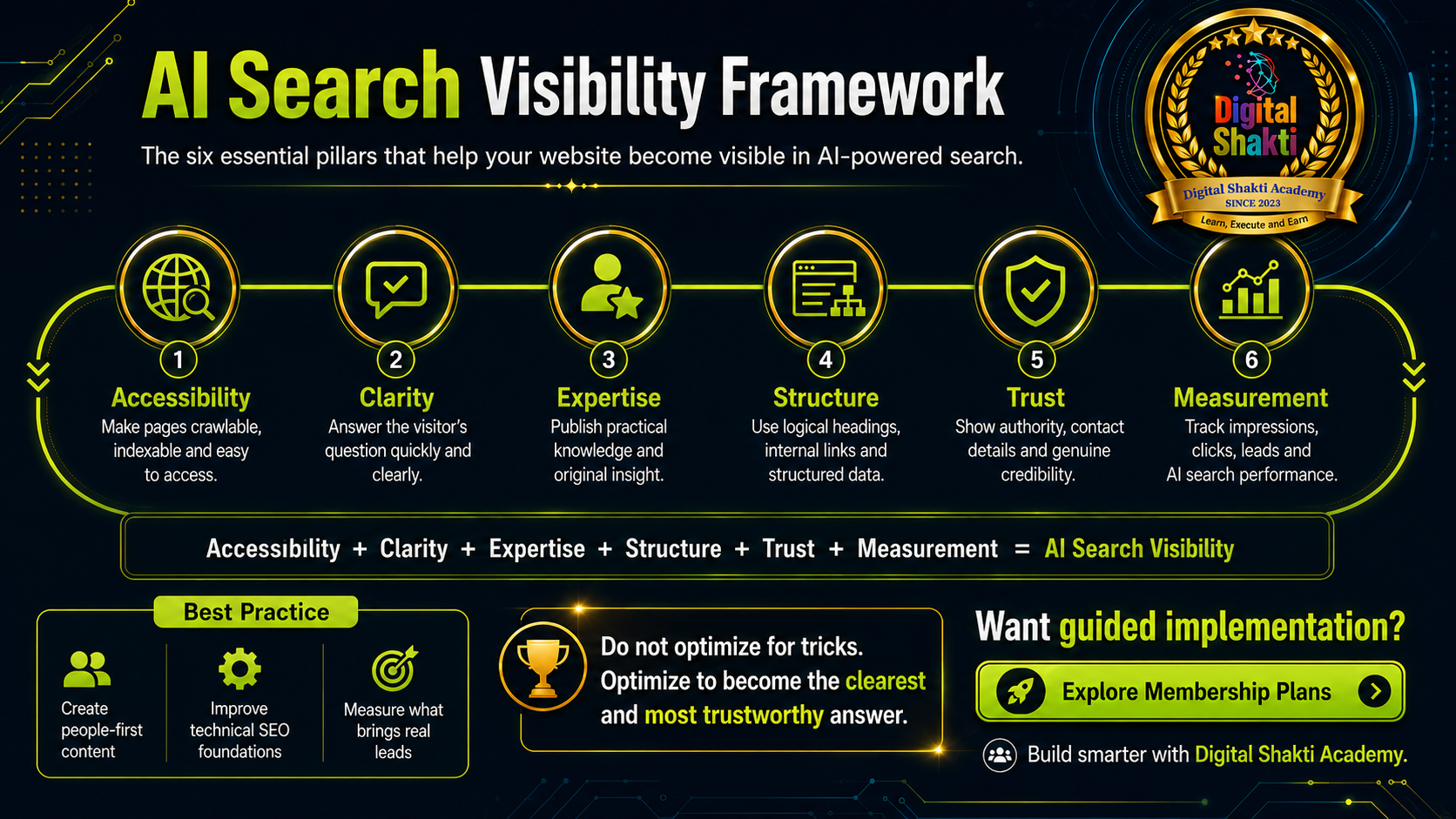
A practical AI-search readiness model contains six connected pillars: Accessibility, Clarity, Expertise, Structure, Trust and Measurement.
1. Accessibility
Important pages must be crawlable, indexable and reachable through internal links. Maintain a valid XML sitemap, avoid accidental noindex directives, use canonical URLs where needed and ensure essential content is available on mobile and desktop.
2. Clarity
Each page should answer one primary question. Use a descriptive headline, a direct opening answer, logical headings, concise explanations, examples and one clear next step.
3. Expertise
Publish information that reflects first-hand experience, project knowledge, original analysis, real examples, screenshots, calculations, checklists or case studies. Generic summaries are easier to replace and less memorable.
4. Structure
Organize pages in a predictable sequence: topic, direct answer, explanation, framework, evidence, FAQs and CTA. Use semantic headings and relevant structured data, but never add markup that does not match visible page content.
5. Trust
Display the author, founder or reviewer; provide accurate contact information, business details, policies, genuine testimonials, project evidence and reliable sources. Google’s people-first guidance encourages clear authorship and demonstrable experience.
6. Measurement
Track visibility, pages, queries, leads and conversions. In June 2026, Google launched dedicated generative AI performance reports in Search Console for a subset of sites, including views for impressions, pages, countries, devices and dates.
4. Create Content Around Complete Customer Questions
Keyword research remains useful, but an effective 2026 content strategy should also reflect the complete questions people ask. Google explains that AI systems may use related query fan-out to gather additional information, so useful pages should cover the subject naturally without creating a separate thin page for every keyword variation.
Instead of targeting only a broad term such as “website development,” build expert content around specific intent:
- How much does a business website cost in India?
- Which pages should a consultant or professional website include?
- Why is my website receiving traffic but no enquiries?
- Should a small business build a website or mobile app first?
- How can WhatsApp, CRM and AI improve lead follow-up?
- How can a local business prepare for visibility in AI search?
Each article should solve one real problem, provide a practical outcome and connect naturally to a service, checklist, webinar or course.
5. Use AI to Support Content—Not Replace Expertise
AI tools can accelerate research, outlines, headline options, grammar improvement, FAQ discovery and content repurposing. They should not replace accountability, verification or original insight.
Before publishing AI-assisted content, add:
- Human experience and a defined audience.
- Original examples, analysis or project observations.
- Fact-checking against reliable primary sources.
- Practical implementation steps and a useful next action.
- Expert review and transparent authorship.
THE RIGHT CONTENT FORMULA AI Assistance + Human Expertise + Original Value = More Useful Content |
Google permits useful AI-assisted content, but scaled production of low-value pages primarily intended to manipulate rankings can violate its spam policies.
6. What You Do Not Need for Google AI Search
Google’s updated guide directly addresses several common myths. For Google Search visibility, you do not need a special llms.txt file, AI-specific markup, artificial mentions, tiny content chunks or a separate writing style designed only for AI systems. Structured data remains useful for eligible Search features, but there is no special schema required for AI Mode.
- Avoid secret ranking claims and unsupported GEO hacks.
- Avoid mass-produced content that adds no original value.
- Avoid keyword stuffing and pages created for every minor query variation.
- Avoid inauthentic brand mentions or paid references presented as independent evidence.
- Avoid structured data that does not accurately represent the visible page.
Focus resources on useful information, technical accessibility, real credibility and a satisfying visitor experience.
7. Ten-Point AI Search Readiness Check
- The page answers one clear customer question.
- A direct answer appears near the beginning.
- The content includes genuine expertise, research or experience.
- Examples, evidence or practical steps add value beyond a generic summary.
- Google can crawl and index the page.
- The page works well on mobile and is easy to navigate.
- The title, headings, images and internal links are descriptive.
- Relevant structured data is accurate and technically valid.
- Author, business and contact details are visible.
- A clear CTA connects the visitor to the next logical step.
A high score strengthens readiness but cannot guarantee indexing, ranking or inclusion in an AI-generated response.
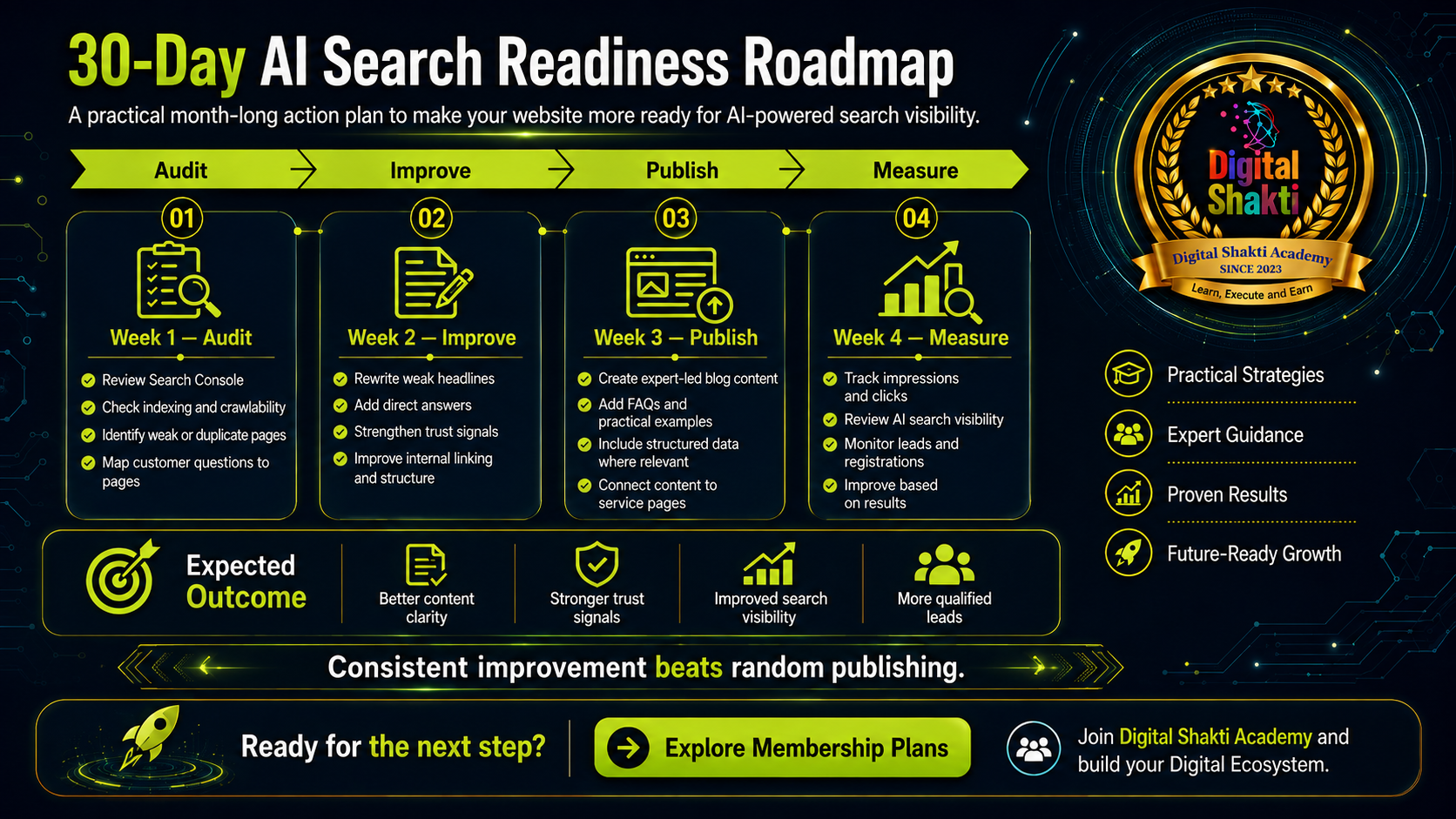
8. A Practical 30-Day AI Search Action Plan
Stage | Priority Actions |
Week 1 — Audit | Review Search Console, indexing, sitemaps, important URLs, mobile usability, duplicate pages and the customer questions connected to each service. |
Week 2 — Improve | Rewrite unclear headlines, add direct answers, strengthen author and trust signals, improve internal links and correct relevant structured data. |
Week 3 — Publish | Create three expert-led articles that answer high-intent customer questions with original examples, visuals and a clear CTA. |
Week 4 — Measure | Track impressions, pages, queries, AI-feature visibility where available, engagement, downloads, webinar registrations and service enquiries. |
Conclusion
AI-powered search is not the end of SEO. It is the next stage of search discovery.
To improve visibility in Google AI Mode and AI Overviews, make your website technically accessible, create unique and useful content, show genuine expertise, build visible trust and measure whether Search brings the right people into your ecosystem.
The strongest long-term strategy is not to publish the highest volume of content. It is to become the clearest, most useful and most credible source for a defined audience.
IS YOUR WEBSITE READY FOR AI SEARCH? Request a structured review of technical SEO, content clarity, trust signals, structured data, AI-search readiness and the lead-conversion journey. CONTINUE YOUR DIGITAL CEO JOURNEY || REQUEST MY AI SEARCH WEBSITE AUDIT |